Build a Scalable VXLAN Overlay for a Kubernetes CNI
Introduction
In Create a Kubernetes CNI Plugin from Scratch, we built a bridge CNI in Bash or Go. It creates a veth pair for each Pod, delegates address allocation to host-local, and connects the host end to cni0.
We ended with one Pod CIDR per node and installed cross-node routes by hand:
1
2
10.244.1.0/24 via <control-plane underlay IP>
10.244.2.0/24 via <worker underlay IP>
That proved the data path, but it did not produce an operable cluster network. Every node addition, removal, Pod CIDR change, or underlay address change would require an administrator to update every other node.
In this follow-on, we will replace those manual routes with a VXLAN overlay managed by a node agent. The agent will discover topology from Kubernetes, install the CNI files, reconcile the Linux data path, repair drift, and remove stale peer state.
The existing CNI executable does not change. Whether you chose Bash or Go in the previous article, the same binary can be reused here.
This remains an educational IPv4 CNI. The agent demonstrates the architecture and reconciliation mechanics, but it does not implement NetworkPolicy, encryption, egress masquerading, dual stack, metrics, leader election, or zero-disruption upgrades.
The New Problem
A CNI executable runs for one Pod sandbox and then exits. It is the wrong lifecycle for cluster-wide concerns:
- watching Nodes join and leave;
- discovering each node’s Pod CIDR and underlay address;
- maintaining tunnels and routes;
- repairing configuration removed by an operator or reboot;
- deleting state for nodes that no longer exist.
Those tasks need a long-running control loop. Production networking systems therefore commonly separate the per-Pod CNI executable from a node-resident agent.
flowchart TB
    API[Kubernetes API<br>Node objects]

    subgraph N1 [Node A]
        A1[cni-node-agent]
        C1[cni-plugin]
        B1[cni0]
        V1[vxlan0]
        A1 -->|writes config| C1
        C1 --> B1
        A1 -->|reconciles| V1
    end

    subgraph N2 [Node B]
        A2[cni-node-agent]
        C2[cni-plugin]
        B2[cni0]
        V2[vxlan0]
        A2 -->|writes config| C2
        C2 --> B2
        A2 -->|reconciles| V2
    end

    API -->|watch Nodes| A1
    API -->|watch Nodes| A2
    V1 <-->|UDP 4789| V2
Design
The Kubernetes controller manager assigns a Pod CIDR to each Node. The kubelet publishes an InternalIP. Together, these fields form the topology database our agent needs:
| Node field | Purpose |
|---|---|
metadata.name | Identifies the local and remote nodes |
metadata.uid | Produces a stable, unique VTEP MAC |
spec.podCIDR | Selects the local IPAM range or a remote route |
status.addresses[InternalIP] | Selects the VXLAN underlay endpoint |
Every agent watches all Node objects through a shared informer. On each event, and every 30 seconds as a safety resync, it computes the complete desired state.
For the local node, it:
- creates
vxlan0with VNI5000and UDP destination port4789; - derives a locally administered VTEP MAC from the Node UID;
- writes a
host-localCNI configuration using the assigned Pod CIDR; - reserves the first usable address as the
cni0gateway; - uses MTU
1450, leaving 50 bytes for the inner Ethernet, VXLAN, UDP, and outer IPv4 headers.
For every remote node, it installs:
- a route for the remote Pod CIDR through the remote gateway on
vxlan0; - a permanent neighbor entry mapping that gateway to the remote VTEP MAC;
- a VXLAN forwarding database entry mapping the VTEP MAC to the remote
InternalIP.
The resulting packet path is:
flowchart LR
    PA[Pod A<br>10.244.1.x] --> BA[cni0<br>10.244.1.1]
    BA --> RA[Route to 10.244.2.0/24]
    RA --> VA[vxlan0]
    VA -->|Ethernet in UDP 4789| VB[vxlan0]
    VB --> RB[Host routing]
    RB --> BB[cni0<br>10.244.2.1]
    BB --> PB[Pod B<br>10.244.2.x]
What VXLAN Adds to the Packet
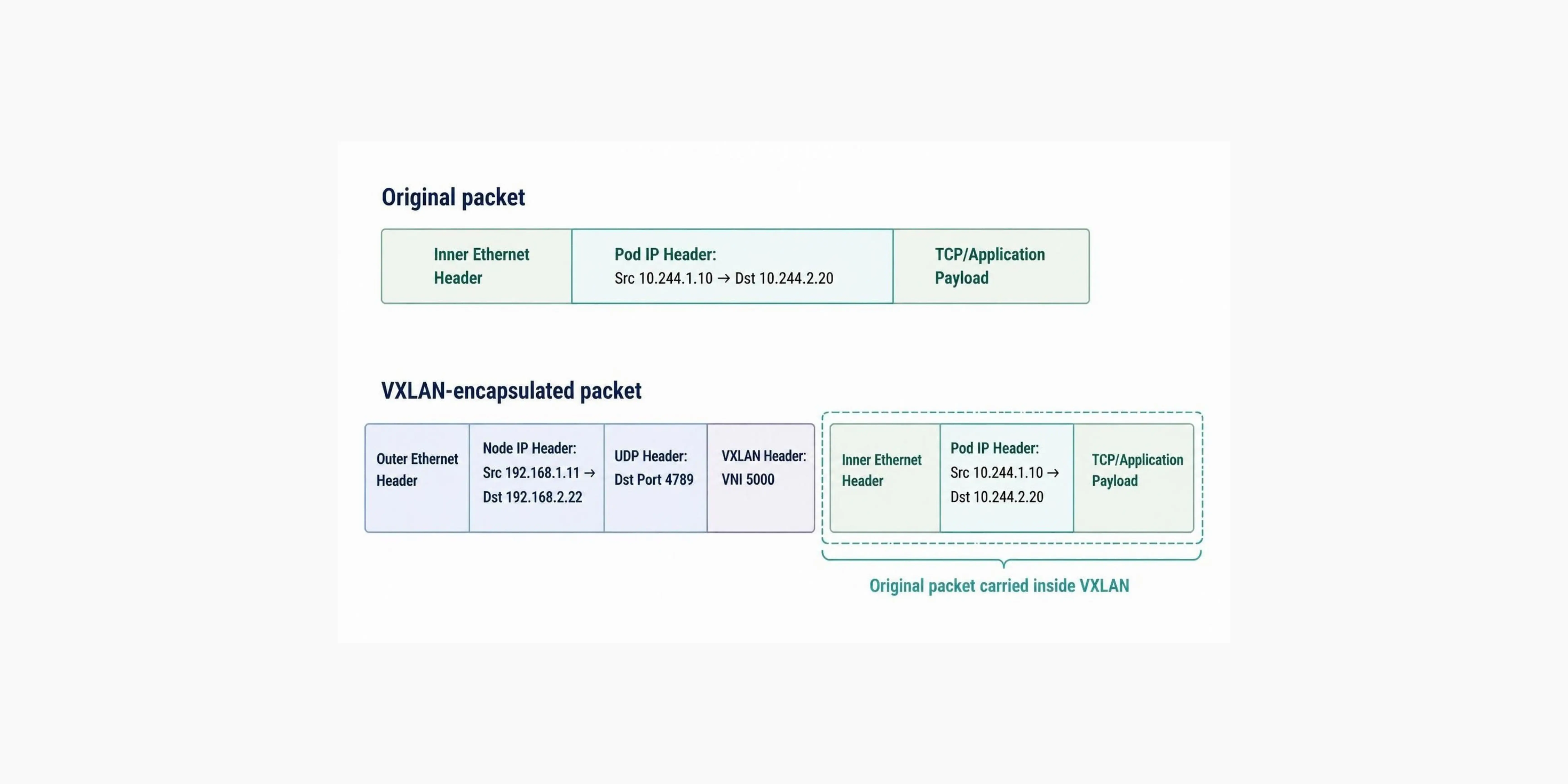
The Pod creates an ordinary IPv4 packet addressed to the remote Pod. At the source node, vxlan0 places that packet inside an inner Ethernet frame, then adds a VXLAN header containing VNI 5000, a UDP header using destination port 4789, and an outer IPv4 header addressed to the remote node. The physical interface adds the outer Ethernet header needed for the next underlay hop.
flowchart TB
    subgraph BEFORE["1 · Before encapsulation: Pod A to vxlan0"]
        direction LR
        BIP["Inner IPv4 · 20 B<br>10.244.1.x → 10.244.2.x"] --- BPAY["ICMP / TCP / UDP payload<br>up to 1430 B"]
    end

    ENC["vxlan0 encapsulates<br>route + neighbor + FDB lookup"]

    subgraph WIRE["2 · On the underlay: Node A to Node B"]
        direction LR
        OE["Outer Ethernet · 14 B<br>next-hop MACs"] --- OIP["Outer IPv4 · 20 B<br>Node A IP → Node B IP"]
        OIP --- UDP["UDP · 8 B<br>destination 4789"]
        UDP --- VX["VXLAN · 8 B<br>VNI 5000"]
        VX --- IE["Inner Ethernet · 14 B<br>source → remote VTEP MAC"]
        IE --- IIP["Inner IPv4 · 20 B<br>10.244.1.x → 10.244.2.x"]
        IIP --- IPAY["Original payload<br>unchanged"]
    end

    DEC["vxlan0 decapsulates<br>removes outer IP, UDP, VXLAN,<br>and inner Ethernet"]

    subgraph AFTER["3 · After decapsulation: vxlan0 to Pod B"]
        direction LR
        AIP["Inner IPv4 · 20 B<br>10.244.1.x → 10.244.2.x"] --- APAY["Original payload<br>unchanged"]
    end

    BEFORE --> ENC --> WIRE --> DEC --> AFTER

    classDef underlay fill:#fff1cc,stroke:#b7791f,color:#4a2c00,stroke-width:2px
    classDef tunnel fill:#f3e8ff,stroke:#7e22ce,color:#3b0764,stroke-width:2px
    classDef overlay fill:#dbeafe,stroke:#2563eb,color:#172554,stroke-width:2px
    classDef payload fill:#e8f5e9,stroke:#2e7d32,color:#153e19,stroke-width:2px
    classDef action fill:#fce7f3,stroke:#be185d,color:#500724,stroke-width:2px

    class OE,OIP,UDP underlay
    class VX tunnel
    class BIP,IE,IIP,AIP overlay
    class BPAY,IPAY,APAY payload
    class ENC,DEC action
The underlay routes only between the node IPs; it does not need routes for Pod CIDRs. VNI 5000 identifies the virtual Layer 2 network, while UDP allows the encapsulated frame to cross the existing Layer 3 underlay. At the destination node, vxlan0 removes the encapsulation and hands the unchanged inner IPv4 packet back to normal host routing.
The 50-byte MTU allowance is 14 bytes of inner Ethernet plus 8 bytes of VXLAN, 8 bytes of UDP, and 20 bytes of outer IPv4. The outer Ethernet header is added outside the underlay’s 1500-byte IP MTU, so it is not part of that calculation.
This is a routed overlay. We do not join cni0 and vxlan0 into one large Layer 2 bridge, and we do not flood unknown Pod destinations across every VTEP. Each node-local Pod subnet remains a separate broadcast domain.
Here, “scalable” means nodes can join and leave without per-node manual commands. The full mesh still stores $N-1$ routes, neighbors, and FDB entries on each node, for $O(N^2)$ aggregate peer state. That model is practical for this lab and many moderate clusters, but very large deployments need additional control-plane engineering, aggregation, or a different route-distribution design.
Prerequisites and Reused Artifacts
Complete the previous article through the installation of host-local, but do not run its cleanup section. The directory $HOME/cni-plugin-lab must contain:
cni-plugin, built for the Docker engine’s Linux architecture;cni-plugins/host-local;- Docker,
kind, andkubectlon the host.
The executable can be either implementation from the previous article. Confirm the reusable files:
1
2
3
4
5
6
cd "$HOME/cni-plugin-lab"
test -x cni-plugin
test -x cni-plugins/host-local
docker version --format '{{.Server.Version}}'
kind version
kubectl version --client
We will reuse the CNI data path and IPAM plugin. We will replace the hand-written per-node CNI files and manual cross-node routes.
1. Create the Node Agent Module
Create a separate Go module. The agent uses the Kubernetes 1.37 client libraries and the same netlink library as the Go CNI implementation. It is compiled inside Docker, so Go 1.26 is not required on the host.
1
2
3
4
5
6
7
8
9
10
11
12
13
14
mkdir -p node-agent
cat > node-agent/go.mod <<'EOF'
module example.com/cni-node-agent

go 1.26.0

require (
	github.com/vishvananda/netlink v1.3.1
	golang.org/x/sys v0.47.0
	k8s.io/api v0.37.1
	k8s.io/apimachinery v0.37.1
	k8s.io/client-go v0.37.1
)
EOF
Create the agent:
1
2
3
4
5
6
7
8
9
10
11
12
13
14
15
16
17
18
19
20
21
22
23
24
25
26
27
28
29
30
31
32
33
34
35
36
37
38
39
40
41
42
43
44
45
46
47
48
49
50
51
52
53
54
55
56
57
58
59
60
61
62
63
64
65
66
67
68
69
70
71
72
73
74
75
76
77
78
79
80
81
82
83
84
85
86
87
88
89
90
91
92
93
94
95
96
97
98
99
100
101
102
103
104
105
106
107
108
109
110
111
112
113
114
115
116
117
118
119
120
121
122
123
124
125
126
127
128
129
130
131
132
133
134
135
136
137
138
139
140
141
142
143
144
145
146
147
148
149
150
151
152
153
154
155
156
157
158
159
160
161
162
163
164
165
166
167
168
169
170
171
172
173
174
175
176
177
178
179
180
181
182
183
184
185
186
187
188
189
190
191
192
193
194
195
196
197
198
199
200
201
202
203
204
205
206
207
208
209
210
211
212
213
214
215
216
217
218
219
220
221
222
223
224
225
226
227
228
229
230
231
232
233
234
235
236
237
238
239
240
241
242
243
244
245
246
247
248
249
250
251
252
253
254
255
256
257
258
259
260
261
262
263
264
265
266
267
268
269
270
271
272
273
274
275
276
277
278
279
280
281
282
283
284
285
286
287
288
289
290
291
292
293
294
295
296
297
298
299
300
301
302
303
304
305
306
307
308
309
310
311
312
313
314
315
316
317
318
319
320
321
322
323
324
325
326
327
328
329
330
331
332
333
334
335
336
337
338
339
340
341
342
343
344
345
346
347
348
349
350
351
352
353
354
355
356
357
358
359
360
361
362
363
364
365
366
367
368
369
370
371
372
373
374
375
376
377
378
379
380
381
382
383
384
385
386
387
388
389
390
391
392
393
394
395
396
397
398
399
cat > node-agent/main.go <<'EOF'
package main
import (
"context"
"crypto/sha256"
"encoding/json"
"errors"
"fmt"
"log"
"net"
"os"
"path/filepath"
"sort"
"time"
"github.com/vishvananda/netlink"
"golang.org/x/sys/unix"
corev1 "k8s.io/api/core/v1"
"k8s.io/apimachinery/pkg/util/wait"
"k8s.io/client-go/informers"
"k8s.io/client-go/kubernetes"
"k8s.io/client-go/rest"
"k8s.io/client-go/tools/cache"
)
const (
vxlanName = "vxlan0"
vxlanVNI = 5000
vxlanPort = 4789
overlayMTU = 1450
routeProtocol = 99
configPath = "/host/etc/cni/net.d/10-cni-plugin.conf"
)
type peer struct {
name string
podCIDR *net.IPNet
gateway net.IP
underlay net.IP
mac net.HardwareAddr
}
type cniConfig struct {
CNIVersion string `json:"cniVersion"`
Name string `json:"name"`
Type string `json:"type"`
Bridge string `json:"bridge"`
MTU int `json:"mtu"`
IPAM ipamConfig `json:"ipam"`
}
type ipamConfig struct {
Type string `json:"type"`
Ranges [][]map[string]string `json:"ranges"`
Routes []map[string]string `json:"routes"`
}
func ipv4PodCIDR(node *corev1.Node) (*net.IPNet, error) {
cidrs := node.Spec.PodCIDRs
if len(cidrs) == 0 && node.Spec.PodCIDR != "" {
cidrs = []string{node.Spec.PodCIDR}
}
for _, value := range cidrs {
ip, network, err := net.ParseCIDR(value)
if err == nil && ip.To4() != nil {
network.IP = ip.To4()
return network, nil
}
}
return nil, fmt.Errorf("node %s has no IPv4 Pod CIDR", node.Name)
}
func internalIPv4(node *corev1.Node) (net.IP, error) {
for _, address := range node.Status.Addresses {
if address.Type == corev1.NodeInternalIP {
if ip := net.ParseIP(address.Address).To4(); ip != nil {
return ip, nil
}
}
}
return nil, fmt.Errorf("node %s has no IPv4 InternalIP", node.Name)
}
func firstUsable(network *net.IPNet) (net.IP, error) {
ones, bits := network.Mask.Size()
if bits != 32 || ones > 30 {
return nil, fmt.Errorf("Pod CIDR %s has no usable gateway address", network)
}
ip := append(net.IP(nil), network.IP.To4()...)
for index := len(ip) - 1; index >= 0; index-- {
ip[index]++
if ip[index] != 0 {
break
}
}
return ip, nil
}
func vtepMAC(uid string) net.HardwareAddr {
digest := sha256.Sum256([]byte(uid))
return net.HardwareAddr{0x02, digest[0], digest[1], digest[2], digest[3], digest[4]}
}
func desiredPeers(nodes []*corev1.Node) ([]peer, error) {
peers := make([]peer, 0, len(nodes))
for _, node := range nodes {
podCIDR, err := ipv4PodCIDR(node)
if err != nil {
return nil, err
}
gateway, err := firstUsable(podCIDR)
if err != nil {
return nil, err
}
underlay, err := internalIPv4(node)
if err != nil {
return nil, err
}
peers = append(peers, peer{
name: node.Name, podCIDR: podCIDR, gateway: gateway,
underlay: underlay, mac: vtepMAC(string(node.UID)),
})
}
sort.Slice(peers, func(i, j int) bool { return peers[i].name < peers[j].name })
return peers, nil
}
func ensureVXLAN(local peer) (*netlink.Vxlan, error) {
link, err := netlink.LinkByName(vxlanName)
if err == nil {
vxlan, ok := link.(*netlink.Vxlan)
if !ok {
return nil, fmt.Errorf("%s exists but is not a VXLAN device", vxlanName)
}
if vxlan.VxlanId != vxlanVNI || vxlan.Port != vxlanPort ||
!vxlan.SrcAddr.Equal(local.underlay) || vxlan.Attrs().MTU != overlayMTU {
if err := netlink.LinkDel(vxlan); err != nil {
return nil, fmt.Errorf("replace incompatible %s: %w", vxlanName, err)
}
link = nil
} else {
if err := netlink.LinkSetHardwareAddr(vxlan, local.mac); err != nil {
return nil, fmt.Errorf("set %s MAC: %w", vxlanName, err)
}
if err := netlink.LinkSetUp(vxlan); err != nil {
return nil, fmt.Errorf("set %s up: %w", vxlanName, err)
}
return vxlan, nil
}
} else {
var notFound netlink.LinkNotFoundError
if !errors.As(err, ¬Found) {
return nil, fmt.Errorf("find %s: %w", vxlanName, err)
}
}
attrs := netlink.NewLinkAttrs()
attrs.Name = vxlanName
attrs.MTU = overlayMTU
attrs.HardwareAddr = local.mac
vxlan := &netlink.Vxlan{
LinkAttrs: attrs,
VxlanId: vxlanVNI,
SrcAddr: local.underlay,
Port: vxlanPort,
Learning: false,
}
if err := netlink.LinkAdd(vxlan); err != nil {
return nil, fmt.Errorf("create %s: %w", vxlanName, err)
}
if err := netlink.LinkSetUp(vxlan); err != nil {
return nil, fmt.Errorf("set %s up: %w", vxlanName, err)
}
return vxlan, nil
}
func ensureRemote(vxlan *netlink.Vxlan, remote peer) error {
route := &netlink.Route{
LinkIndex: vxlan.Index,
Dst: remote.podCIDR,
Gw: remote.gateway,
Protocol: netlink.RouteProtocol(routeProtocol),
Flags: int(netlink.FLAG_ONLINK),
}
if err := netlink.RouteReplace(route); err != nil {
return fmt.Errorf("route %s: %w", remote.podCIDR, err)
}
neighbor := &netlink.Neigh{
LinkIndex: vxlan.Index,
Family: unix.AF_INET,
State: unix.NUD_PERMANENT,
IP: remote.gateway,
HardwareAddr: remote.mac,
}
if err := netlink.NeighSet(neighbor); err != nil {
return fmt.Errorf("neighbor %s: %w", remote.gateway, err)
}
fdb := &netlink.Neigh{
LinkIndex: vxlan.Index,
Family: unix.AF_BRIDGE,
State: unix.NUD_PERMANENT,
Flags: unix.NTF_SELF,
IP: remote.underlay,
HardwareAddr: remote.mac,
}
if err := netlink.NeighSet(fdb); err != nil {
return fmt.Errorf("FDB %s: %w", remote.underlay, err)
}
return nil
}
func cleanupRoutes(vxlan *netlink.Vxlan, desired map[string]struct{}) error {
routes, err := netlink.RouteList(vxlan, netlink.FAMILY_V4)
if err != nil {
return err
}
for _, route := range routes {
if int(route.Protocol) != routeProtocol || route.Dst == nil {
continue
}
if _, ok := desired[route.Dst.String()]; !ok {
stale := route
if err := netlink.RouteDel(&stale); err != nil {
return err
}
}
}
return nil
}
func cleanupNeighbors(vxlan *netlink.Vxlan, family int, desired map[string]struct{}) error {
neighbors, err := netlink.NeighList(vxlan.Index, family)
if err != nil {
return err
}
for _, neighbor := range neighbors {
if neighbor.State != unix.NUD_PERMANENT {
continue
}
if family == unix.AF_BRIDGE && (neighbor.Flags&unix.NTF_SELF == 0 || neighbor.IP == nil) {
continue
}
key := neighbor.IP.String()
if family == unix.AF_BRIDGE {
key = neighbor.HardwareAddr.String() + "@" + neighbor.IP.String()
}
if _, ok := desired[key]; !ok {
stale := neighbor
if err := netlink.NeighDel(&stale); err != nil {
return err
}
}
}
return nil
}
func writeCNIConfig(local peer) error {
config := cniConfig{
CNIVersion: "1.1.0",
Name: "cni-plugin",
Type: "cni-plugin",
Bridge: "cni0",
MTU: overlayMTU,
IPAM: ipamConfig{
Type: "host-local",
Ranges: [][]map[string]string{{{
"subnet": local.podCIDR.String(),
"gateway": local.gateway.String(),
}}},
Routes: []map[string]string{{"dst": "0.0.0.0/0"}},
},
}
data, err := json.MarshalIndent(config, "", " ")
if err != nil {
return err
}
data = append(data, '\n')
if err := os.MkdirAll(filepath.Dir(configPath), 0755); err != nil {
return err
}
temporary := configPath + ".tmp"
if err := os.WriteFile(temporary, data, 0644); err != nil {
return err
}
return os.Rename(temporary, configPath)
}
func reconcile(nodeName string, nodes []*corev1.Node) error {
peers, err := desiredPeers(nodes)
if err != nil {
return err
}
var local *peer
for index := range peers {
if peers[index].name == nodeName {
local = &peers[index]
break
}
}
if local == nil {
return fmt.Errorf("local node %s not found", nodeName)
}
vxlan, err := ensureVXLAN(*local)
if err != nil {
return err
}
desiredRoutes := map[string]struct{}{}
desiredNeighbors := map[string]struct{}{}
desiredFDB := map[string]struct{}{}
for _, remote := range peers {
if remote.name == nodeName {
continue
}
if err := ensureRemote(vxlan, remote); err != nil {
return err
}
desiredRoutes[remote.podCIDR.String()] = struct{}{}
desiredNeighbors[remote.gateway.String()] = struct{}{}
desiredFDB[remote.mac.String()+"@"+remote.underlay.String()] = struct{}{}
}
if err := cleanupRoutes(vxlan, desiredRoutes); err != nil {
return fmt.Errorf("clean routes: %w", err)
}
if err := cleanupNeighbors(vxlan, unix.AF_INET, desiredNeighbors); err != nil {
return fmt.Errorf("clean neighbors: %w", err)
}
if err := cleanupNeighbors(vxlan, unix.AF_BRIDGE, desiredFDB); err != nil {
return fmt.Errorf("clean FDB: %w", err)
}
if err := writeCNIConfig(*local); err != nil {
return fmt.Errorf("write CNI config: %w", err)
}
log.Printf("reconciled %d nodes, local Pod CIDR %s", len(peers), local.podCIDR)
return nil
}
func main() {
nodeName := os.Getenv("NODE_NAME")
if nodeName == "" {
log.Fatal("NODE_NAME is required")
}
config, err := rest.InClusterConfig()
if err != nil {
log.Fatal(err)
}
client, err := kubernetes.NewForConfig(config)
if err != nil {
log.Fatal(err)
}
ctx, cancel := context.WithCancel(context.Background())
defer cancel()
factory := informers.NewSharedInformerFactory(client, 0)
informer := factory.Core().V1().Nodes().Informer()
trigger := make(chan struct{}, 1)
enqueue := func() {
select {
case trigger <- struct{}{}:
default:
}
}
_, err = informer.AddEventHandler(cache.ResourceEventHandlerFuncs{
AddFunc: func(any) { enqueue() },
UpdateFunc: func(any, any) { enqueue() },
DeleteFunc: func(any) { enqueue() },
})
if err != nil {
log.Fatal(err)
}
factory.Start(ctx.Done())
if !cache.WaitForCacheSync(ctx.Done(), informer.HasSynced) {
log.Fatal("Node informer cache did not sync")
}
reconcileAll := func() {
objects := informer.GetStore().List()
nodes := make([]*corev1.Node, 0, len(objects))
for _, object := range objects {
nodes = append(nodes, object.(*corev1.Node))
}
if err := reconcile(nodeName, nodes); err != nil {
log.Printf("reconcile failed: %v", err)
}
}
enqueue()
wait.UntilWithContext(ctx, func(context.Context) {
select {
case <-trigger:
case <-time.After(30 * time.Second):
}
reconcileAll()
}, time.Second)
}
EOF
There are several deliberate details in this implementation:
- The informer provides event-driven discovery without polling the API on every reconciliation.
- The 30-second resync repairs local drift even when no Node object changes.
routeProtocol = 99marks routes owned by this agent, so cleanup does not delete routes managed by another component.- Permanent neighbor and FDB entries avoid ARP flooding across all VTEPs.
- The CNI configuration is written to a temporary file and renamed atomically, so containerd never reads partial JSON.
- The config is written only after the VXLAN state succeeds. A node does not become available for ordinary Pods with a half-configured overlay.
2. Package the CNI and Agent
The node image contains three executables:
- the unchanged
cni-pluginfrom the previous article; - the standard
host-localIPAM plugin; - the new long-running
cni-node-agent.
1
2
3
4
5
6
7
8
9
10
11
12
13
14
15
16
cat > Dockerfile.node-agent <<'EOF'
FROM golang:1.26.2-alpine3.22 AS build
WORKDIR /src
COPY node-agent/go.mod node-agent/main.go ./
RUN go mod tidy
RUN CGO_ENABLED=0 go build -trimpath -o /out/cni-node-agent .

FROM alpine:3.22
RUN apk add --no-cache ca-certificates
COPY --from=build /out/cni-node-agent /usr/local/bin/cni-node-agent
COPY cni-plugin /opt/cni-bundle/cni-plugin
COPY cni-plugins/host-local /opt/cni-bundle/host-local
ENTRYPOINT ["/usr/local/bin/cni-node-agent"]
EOF

docker build -f Dockerfile.node-agent -t cni-node-agent:v1 .
The image is node-architecture-specific because it includes the existing CNI and IPAM binaries. Build it with the same Docker engine that will run the kind nodes.
3. Create a Three-Node Cluster
Use three nodes so discovery is not accidentally coupled to a single peer. As before, disable kind’s default CNI. The controller manager will allocate one /24 from 10.244.0.0/16 to each Node.
1
2
3
4
5
6
7
8
9
10
11
12
13
14
15
16
17
18
19
20
cat > kind-vxlan.yaml <<'EOF'
kind: Cluster
apiVersion: kind.x-k8s.io/v1alpha4
name: cni-vxlan
networking:
  disableDefaultCNI: true
  podSubnet: 10.244.0.0/16
  serviceSubnet: 10.96.0.0/16
nodes:
- role: control-plane
  image: kindest/node:v1.37.0@sha256:a1ed56cfb0e7b93589bdf97c8cd566405a265939e3620fc4f5de89adff580ae5
- role: worker
  image: kindest/node:v1.37.0@sha256:a1ed56cfb0e7b93589bdf97c8cd566405a265939e3620fc4f5de89adff580ae5
- role: worker
  image: kindest/node:v1.37.0@sha256:a1ed56cfb0e7b93589bdf97c8cd566405a265939e3620fc4f5de89adff580ae5
EOF

kind delete cluster --name cni-vxlan
kind create cluster --config kind-vxlan.yaml
kind load docker-image cni-node-agent:v1 --name cni-vxlan
At this point the nodes are expected to be NotReady: containerd has no CNI configuration yet. Confirm that Kubernetes allocated distinct CIDRs:
1
kubectl get nodes -o 'custom-columns=NAME:.metadata.name,POD_CIDR:.spec.podCIDR,INTERNAL_IP:.status.addresses[0].address'
Do not hard-code the values printed by this command. The agent consumes the Node objects directly.
4. Deploy the Node Agent
The agent only reads Node objects from the API, so its ClusterRole grants exactly get, list, and watch on nodes.
It runs with host networking because it must bootstrap networking before ordinary Pod sandboxes can start. Kubernetes automatically tolerates node.kubernetes.io/network-unavailable for host-network DaemonSet Pods, avoiding a dependency cycle.
The main container receives NET_ADMIN in the host network namespace and mounts the host CNI configuration directory. An init container copies the CNI and IPAM executables into the host’s CNI binary directory.
1
2
3
4
5
6
7
8
9
10
11
12
13
14
15
16
17
18
19
20
21
22
23
24
25
26
27
28
29
30
31
32
33
34
35
36
37
38
39
40
41
42
43
44
45
46
47
48
49
50
51
52
53
54
55
56
57
58
59
60
61
62
63
64
65
66
67
68
69
70
71
72
73
74
75
76
77
78
79
80
81
82
83
84
85
86
87
88
89
90
91
92
93
94
95
96
97
98
99
100
101
102
103
cat > cni-node-agent.yaml <<'EOF'
apiVersion: v1
kind: ServiceAccount
metadata:
  name: cni-node-agent
  namespace: kube-system
---
apiVersion: rbac.authorization.k8s.io/v1
kind: ClusterRole
metadata:
  name: cni-node-agent
rules:
- apiGroups: [""]
  resources: ["nodes"]
  verbs: ["get", "list", "watch"]
---
apiVersion: rbac.authorization.k8s.io/v1
kind: ClusterRoleBinding
metadata:
  name: cni-node-agent
roleRef:
  apiGroup: rbac.authorization.k8s.io
  kind: ClusterRole
  name: cni-node-agent
subjects:
- kind: ServiceAccount
  name: cni-node-agent
  namespace: kube-system
---
apiVersion: apps/v1
kind: DaemonSet
metadata:
  name: cni-node-agent
  namespace: kube-system
spec:
  selector:
    matchLabels:
      app: cni-node-agent
  template:
    metadata:
      labels:
        app: cni-node-agent
    spec:
      hostNetwork: true
      priorityClassName: system-node-critical
      serviceAccountName: cni-node-agent
      tolerations:
      - operator: Exists
      initContainers:
      - name: install-cni
        image: cni-node-agent:v1
        imagePullPolicy: Never
        command: ["/bin/sh", "-ec"]
        args:
        - |
          install -m 0755 /opt/cni-bundle/cni-plugin /host/opt/cni/bin/cni-plugin
          install -m 0755 /opt/cni-bundle/host-local /host/opt/cni/bin/host-local
        volumeMounts:
        - name: cni-bin
          mountPath: /host/opt/cni/bin
      containers:
      - name: agent
        image: cni-node-agent:v1
        imagePullPolicy: Never
        securityContext:
          runAsUser: 0
          capabilities:
            add: ["NET_ADMIN"]
        env:
        - name: NODE_NAME
          valueFrom:
            fieldRef:
              fieldPath: spec.nodeName
        readinessProbe:
          exec:
            command:
            - /bin/sh
            - -ec
            - test -f /host/etc/cni/net.d/10-cni-plugin.conf && test -d /sys/class/net/vxlan0
          periodSeconds: 2
        resources:
          requests:
            cpu: 20m
            memory: 32Mi
          limits:
            memory: 128Mi
        volumeMounts:
        - name: cni-conf
          mountPath: /host/etc/cni/net.d
      volumes:
      - name: cni-bin
        hostPath:
          path: /opt/cni/bin
          type: Directory
      - name: cni-conf
        hostPath:
          path: /etc/cni/net.d
          type: DirectoryOrCreate
EOF

kubectl apply -f cni-node-agent.yaml
kubectl rollout status daemonset/cni-node-agent -n kube-system --timeout=180s
kubectl wait --for=condition=Ready nodes --all --timeout=180s
The DaemonSet is privileged in a narrower sense than privileged: true: the agent receives CAP_NET_ADMIN, host networking, and write access to the CNI directory. This is still powerful node-level access and should be treated as part of the trusted cluster networking stack.
5. Inspect the Reconciled State
Every node should now have a configuration derived from its own assigned Pod CIDR:
1
2
3
4
for node in cni-vxlan-control-plane cni-vxlan-worker cni-vxlan-worker2; do
  echo "--- $node"
  docker exec "$node" cat /etc/cni/net.d/10-cni-plugin.conf
done
Inspect the local tunnel and remote routes:
1
2
3
4
5
6
7
for node in cni-vxlan-control-plane cni-vxlan-worker cni-vxlan-worker2; do
  echo "--- $node"
  docker exec "$node" ip -details link show vxlan0
  docker exec "$node" ip -4 route show protocol 99
  docker exec "$node" ip neigh show dev vxlan0
  docker exec "$node" bridge fdb show dev vxlan0
done
On each node, expect:
- one route for each of the other two Pod CIDRs;
- one permanent neighbor entry for each remote bridge gateway;
- one permanent FDB entry mapping each remote VTEP MAC to its underlay IP;
- VNI
5000, destination port4789, and MTU1450onvxlan0.
6. Test the Overlay End to End
Create one Pod on each node. The control-plane Pod needs a toleration for its default taint.
1
2
3
4
5
6
7
8
9
10
11
12
13
14
kubectl run pod-control \
  --image=registry.k8s.io/e2e-test-images/agnhost:2.53 \
  --overrides='{"spec":{"nodeSelector":{"kubernetes.io/hostname":"cni-vxlan-control-plane"},"tolerations":[{"operator":"Exists"}],"containers":[{"name":"pod-control","image":"registry.k8s.io/e2e-test-images/agnhost:2.53","args":["pause"]}]}}'

kubectl run pod-worker-1 \
  --image=registry.k8s.io/e2e-test-images/agnhost:2.53 \
  --overrides='{"spec":{"nodeSelector":{"kubernetes.io/hostname":"cni-vxlan-worker"},"containers":[{"name":"pod-worker-1","image":"registry.k8s.io/e2e-test-images/agnhost:2.53","args":["pause"]}]}}'

kubectl run pod-worker-2 \
  --image=registry.k8s.io/e2e-test-images/agnhost:2.53 \
  --overrides='{"spec":{"nodeSelector":{"kubernetes.io/hostname":"cni-vxlan-worker2"},"containers":[{"name":"pod-worker-2","image":"registry.k8s.io/e2e-test-images/agnhost:2.53","args":["pause"]}]}}'

kubectl wait --for=condition=Ready pod/pod-control pod/pod-worker-1 pod/pod-worker-2 --timeout=180s
kubectl get pods -o wide
Test every cross-node direction without manually copying addresses:
1
2
3
4
5
6
7
8
9
10
CONTROL_IP=$(kubectl get pod pod-control -o jsonpath='{.status.podIP}')
WORKER_1_IP=$(kubectl get pod pod-worker-1 -o jsonpath='{.status.podIP}')
WORKER_2_IP=$(kubectl get pod pod-worker-2 -o jsonpath='{.status.podIP}')

kubectl exec pod-control -- ping -c 3 "$WORKER_1_IP"
kubectl exec pod-control -- ping -c 3 "$WORKER_2_IP"
kubectl exec pod-worker-1 -- ping -c 3 "$CONTROL_IP"
kubectl exec pod-worker-1 -- ping -c 3 "$WORKER_2_IP"
kubectl exec pod-worker-2 -- ping -c 3 "$CONTROL_IP"
kubectl exec pod-worker-2 -- ping -c 3 "$WORKER_1_IP"
Verify the MTU boundary. An ICMP payload of 1422 bytes plus 8 bytes of ICMP and 20 bytes of inner IPv4 headers produces a 1450-byte inner packet. The inner Ethernet, VXLAN, UDP, and outer IPv4 headers add 50 bytes, producing a 1500-byte outer IPv4 packet:
1
2
kubectl exec pod-worker-1 -- ip -o link show eth0 | grep 'mtu 1450'
kubectl exec pod-worker-1 -- ping -s 1422 -c 3 "$WORKER_2_IP"
The interface check confirms that the CNI applied the overlay MTU, and the ping sends the largest inner IPv4 ICMP packet that fits within it. The BusyBox ping in the pinned agnhost image does not expose a don’t-fragment option, so this command does not claim to test path MTU discovery. One additional payload byte would exceed the Pod interface MTU and require fragmentation or a smaller segment from the application.
7. Prove Reconciliation
A setup script creates state once. A controller continuously restores desired state. Delete one managed route from the first worker:
1
2
3
CONTROL_CIDR=$(kubectl get node cni-vxlan-control-plane -o jsonpath='{.spec.podCIDR}')
docker exec cni-vxlan-worker ip route delete "$CONTROL_CIDR"
docker exec cni-vxlan-worker ip route show "$CONTROL_CIDR"
Wait for the 30-second safety resync, then verify that the agent restored it:
1
2
3
4
5
6
7
8
9
10
11
for attempt in $(seq 1 40); do
  if docker exec cni-vxlan-worker ip route show "$CONTROL_CIDR" | grep -q vxlan0; then
    echo "Route reconciled"
    break
  fi
  sleep 1
done
docker exec cni-vxlan-worker ip route show "$CONTROL_CIDR"
kubectl logs -n kube-system \
  "$(kubectl get pod -n kube-system -l app=cni-node-agent --field-selector spec.nodeName=cni-vxlan-worker -o jsonpath='{.items[0].metadata.name}')" \
  --tail=5
Node additions and removals follow the event-driven path rather than waiting for the resync. When the informer observes a changed Node list, every agent recomputes routes, neighbors, and FDB entries. Entries no longer present in desired state are deleted only from the resources owned by this agent.
Failure Boundaries
The separation between the CNI and node agent is now explicit:
| Failure | Effect |
|---|---|
CNI ADD fails | One Pod sandbox fails; the plugin rolls back its veth and IP allocation |
| Agent cannot read Nodes | Existing data-plane state continues, but topology changes are not learned |
| Agent crashes | Existing kernel state remains; the DaemonSet restarts the agent |
| VXLAN state is deleted | Cross-node traffic fails until the next reconciliation |
| CNI config is absent | New ordinary Pods cannot start; the host-network agent can still repair it |
| Remote node disappears | Its state remains until Kubernetes removes its Node object, then reconciliation deletes it |
This design intentionally favors continuity: stopping the agent does not tear down a working data path.
Security and Production Gaps
The agent has only read access to the Kubernetes API, but CAP_NET_ADMIN in the host network namespace and writable host CNI paths are highly privileged capabilities. Protect the image supply chain and restrict who can modify the DaemonSet.
Before treating this as production networking, add at least:
- health and readiness based on successful reconciliation, not only file and link existence;
- Prometheus metrics and structured event reporting;
- graceful, version-aware upgrades of the CNI binaries and configuration;
- API-server outage tests and cached-topology behavior;
- underlay interface and MTU discovery instead of fixed
1450; - IPv6 or dual-stack reconciliation;
- NetworkPolicy enforcement;
- egress masquerading where external networks cannot route Pod CIDRs;
- validation that Pod CIDRs do not overlap;
- collision detection for deterministic VTEP MAC addresses;
- filtering and rate-limiting Node updates so unrelated status changes do not trigger full reconciliation;
- network namespaces or test nodes for destructive reconciliation tests;
- an explicit policy for nodes with multiple eligible
InternalIPaddresses.
VXLAN provides isolation by VNI, not encryption or authentication. Anyone with access to the underlay and UDP port 4789 may be able to inject encapsulated traffic unless the underlay is separately protected.
Clean Up
Delete workload Pods and the DaemonSet first:
1
2
kubectl delete pod pod-control pod-worker-1 pod-worker-2 --ignore-not-found
kubectl delete -f cni-node-agent.yaml --ignore-not-found
Deleting the DaemonSet deliberately leaves kernel state intact. For this lab, remove the owned resources before deleting the cluster:
1
2
3
4
5
6
for node in cni-vxlan-control-plane cni-vxlan-worker cni-vxlan-worker2; do
  docker exec "$node" ip link delete vxlan0 2>/dev/null || true
  docker exec "$node" rm -f /etc/cni/net.d/10-cni-plugin.conf
  docker exec "$node" rm -f /opt/cni/bin/cni-plugin /opt/cni/bin/host-local
done
kind delete cluster --name cni-vxlan
Remove the generated sequel files while keeping the reusable artifacts from the first article:
1
rm -rf node-agent Dockerfile.node-agent kind-vxlan.yaml cni-node-agent.yaml
Conclusion
The original CNI plugin solved the per-Pod problem: create a veth, allocate an address, configure the namespace, and clean it up. The node agent solves the cluster problem:
- discover node-local and remote topology from Kubernetes;
- turn Node Pod CIDRs into local IPAM configuration;
- turn remote Pod CIDRs into VXLAN routes, neighbors, and FDB entries;
- continuously repair drift and remove stale state.
This separation is the important architectural step. The CNI executable stays small and synchronous, while a long-running reconciler owns shared host state. VXLAN changes how packets cross the underlay, but it does not require rewriting the Pod attachment path we already built.